 GradBrew
Crack Top Master in Finance or Master of Financial Engineering Programs Get coaching for finance-heavy applications— specialised essays to intensive interviews
A Master in Finance (MFin) or Master of Financial Engineering (MFE) is a 9–18 month, quant-focused master's for early-career graduates and analysts (0–4 years) targeting front-office finance. GradBrew's alumni mentors help you get into programs like MIT Sloan, LBS, and LSE — with ethics-first edits, data-driven strategy, and targeted interview prep.
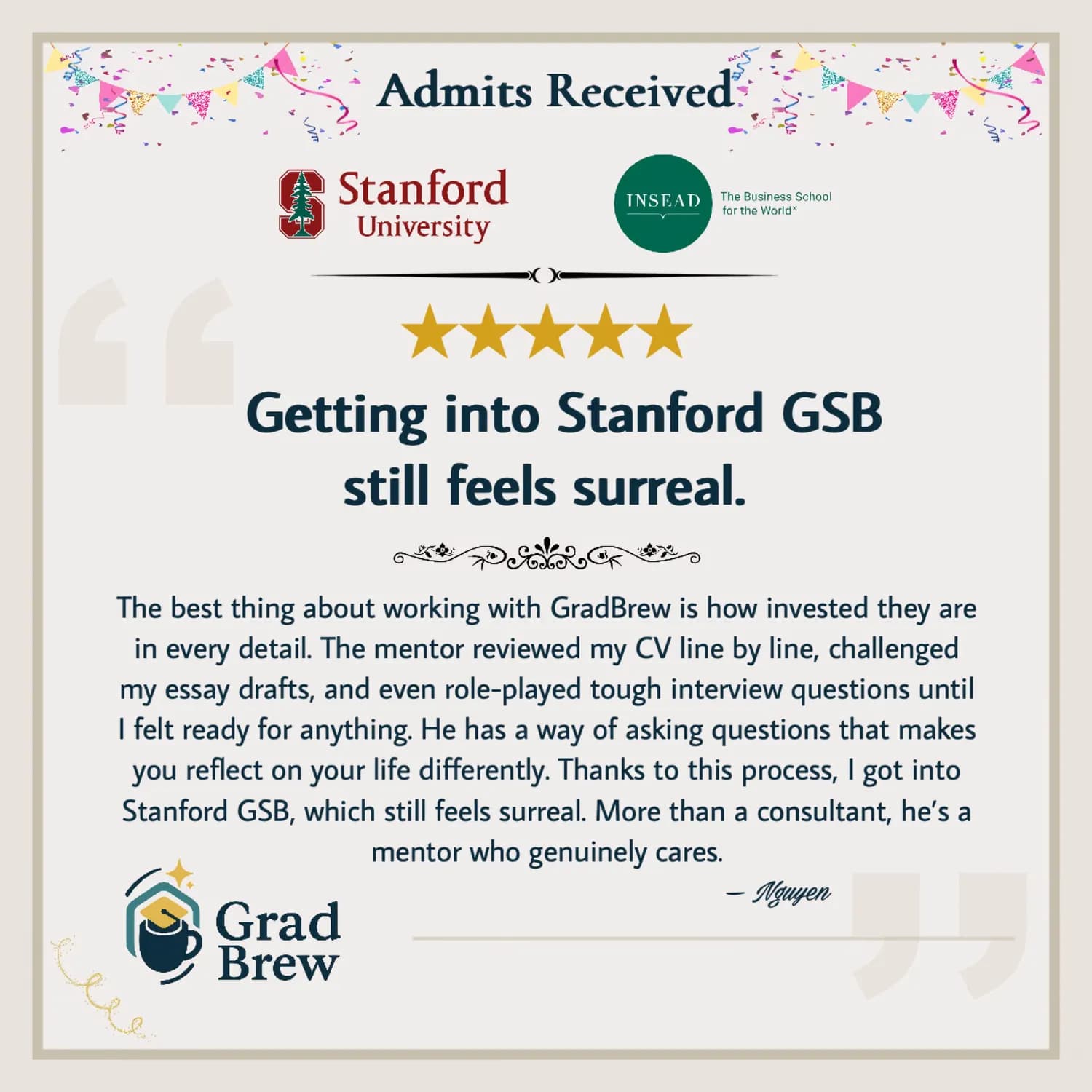
Where Our Mentors Come From & Our Clients Get In








Master in Finance (MFin) / Master of Financial Engineering (MFE) at a Glance
- Target audience: Early-career grads and analysts (0–4 years of experience) with sharp quantitative skills aiming to deepen finance expertise.
- Core focus: Valuation, asset management, quantitative modelling, and Python/R (mandatory for MFE) for markets, built to meet CFA and desk-ready standards.
- Career outcomes: Front-office roles in investment banking, buy-side asset management, quant research, risk, and corporate–finance leadership tracks.
- Degree format: A rigorous 9- to 18-month programme mixing casework, live trading labs, and practicum projects with top financial institutions.
- Network effect: Tap an alumni base embedded at bulge-bracket banks, hedge funds, and PE/VC firms—plus direct recruiting pipelines and CFA partnerships.
Who Should Apply?
- 0–4 yrs experience— internships or early roles in finance, analytics, or engineering that show quantitative aptitude.
- Quant-friendly degree— finance, economics, STEM, or any major with strong math grades and a solid GPA.
- GMAT/GRE or CFA Level 1 (or above) — competitive scores (or CFA progress) to prove technical finance readiness.
- Programming edge (mandatory for MFE)— Advanced Python/R/Programming skills boosts profile for Financial Engineering programs.
- English-ready— TOEFL/IELTS only if your prior studies weren’t in English.
- Clear finance pathway— a defined goal in IB, asset management, quant research, or corporate finance.
- Global intakes— most cohorts begin in September; a few EU and UK schools offer January starts.
MFin vs MFE: Which Finance Master's Is Right for You?
- Focus: MFin covers broad finance (valuation, asset management, corporate finance); MFE is quantitative and computational (derivatives, stochastic modelling).
- Background: MFin suits finance, economics, or business grads; MFE expects a STEM-heavy profile with strong math.
- Programming: useful for MFin; effectively mandatory (Python/R/C++) for MFE.
- Typical roles: MFin → investment banking, asset management, corporate finance; MFE → quant trading, quant research, risk.
- Length: both run roughly 9–18 months.
Why choose GradBrew for your MFin or MFE?









Why are we better than Others?
GradBrew vs typical admission consultancies — across the decisions that actually shape your admit.
Tailored made pricing plans for your MFin journey
By proceeding with the payment, you confirm that you have read and agreed to GradBrew’s Terms & Conditions, Privacy Policy, and Refund & Payment Policy. All services are advisory in nature and do not guarantee admissions, scholarships, or outcomes. Refunds are subject to eligibility criteria and service initiation status. Please review your selected package and school count carefully before proceeding. For installment plans, full access to services is granted only upon receipt of the final payment.
Start your admissions journey with GradBrew
After checkout, our team will reach out and set up all your tools within 24 hours of purchase.
Your journey begins right away: you’ll receive onboarding emails, connect with your mentors soon after, and get unlimited edits and real guidance. We stay with you till the job is done.
4 Schools
INR 1,39,000
8 Schools
INR 2,19,000
Your GradBrew MFin or MFE Journey — Step by Step
Kick-off: Complete Your Info Sheet
A fast,high-signal form that captures your academics, experience, and career goals— fueling every tailored move we make next.

Brainstorming: Strategy Call
A focused 1-to-1 session with your Lead Consultant to lock school targets, carve your story, clarify goals (e.g., IB or quant trading), and decide which programs and formats align best with your background.

First Drafts: Using Guidance and Smart Tools
Spin up your first CV, essays, and recommender briefs with smart tools and templates, quick-hit video guides, and tips from your Lead Consultant— all while keeping the voice unmistakably yours.

Consultant Calls and Unlimited Draft Revisions
Your Lead Consultant deep-dives into your drafts and suggests structured edits.
Team works with you to sharpen structure, language, and impact— until every line earns its spot and still sounds unmistakably you.

Final Review by Second Expert Consultant
Once near-final, a second expert (also a top-school alum) reviews your entire essays/SOP with fresh eyes for final polishing and strategy alignment.
Back-to-front audit— spotting gaps, sharpening strategy, and adding the final polish before you hit “Submit Application”.

Submit Strong and Nail the Interview
Application locked. Now we drill for every behavioral and technical question with school-style mock sessions— so you walk in confident and walk out admitted.
Need post-admit help? We’re still on call for visas, housing, and day-one prep.

Frequently asked questions (FAQs)
Master in Finance (MFin) Basics
What is an MFin degree?
What is the MIT Sloan Master of Finance (MFin) acceptance rate?
Eligibility and Fit
Who should apply for an Master of Finance (MFin) or Master of Financial Engineering (MFE)?
Can I apply if I don’t have a finance or quant background?
What’s the difference between Master of Finance (MFin) and Master of Financial Engineering (MFE)?
Application Requirements
Do I need to take the GMAT or GRE?
What other documents are required?
Do I need to know programming for Master of Financial Engineering (MFE) programs?
Timeline and Planning
When should I start preparing my application?
Can I apply while still finishing my undergrad degree?
How long do MFin and MFE programs usually last?
Cost and Scholarships
What’s the tuition cost for MFin/MFE programs?
Are scholarships available?
Can GradBrew help with scholarship essays?
Career Outcomes and Interviews
What careers can I pursue after MFin or MFE?
What is the interview process like?
How strong are job placements for MFin or MFE programs?
GradBrew Support
Can GradBrew help me choose between MFin and MFE?
Do you help with coding tests or quant interview questions?
How is your support different from other consultants?
Program Requirements and Structure
Do I need a finance degree to apply for a Master of Financial Engineering (MFE)?
What technical skills do top Master of Financial Engineering (MFE) programs look for?
How can I prove my quant skills if I don’t have a math-heavy degree?
Are there coding or math tests as part of the Master of Financial Engineering (MFE) admissions process?
What’s the difference between Master of Financial Engineering (MFE) and MS in Quant Finance/Financial Math?
Can I apply for an Master of Financial Engineering (MFE) without work experience?
Are there part-time or online Master of Financial Engineering (MFE) options?
Ready to Power Up Your MFin or MFE Journey with GradBrew?
- Quant-tuned game plan – dual-consultant guidance, AI tools, and a live dashboard that tracks every step from first draft to admit.
- Ethical edge – no ghostwriting or generic templates; just your authentic finance story, sharpened for top MFin & MFE ad-coms.
- Technical-proof confidence – brain-teaser and valuation mock interviews, plus scholarship & test-waiver positioning.
- Post-admit peace of mind – visa, housing, and pre-arrival quant prep, plus early Career Studio access for internship leads (add-on).