 GradBrew
//
Admissions Consulting
Terms and conditionsPrivacy policyRefund, Deferral & Payment TermsDisclaimerCopyright NoticeContact / Impressum
@2026 GradBrew. All rights reserved.
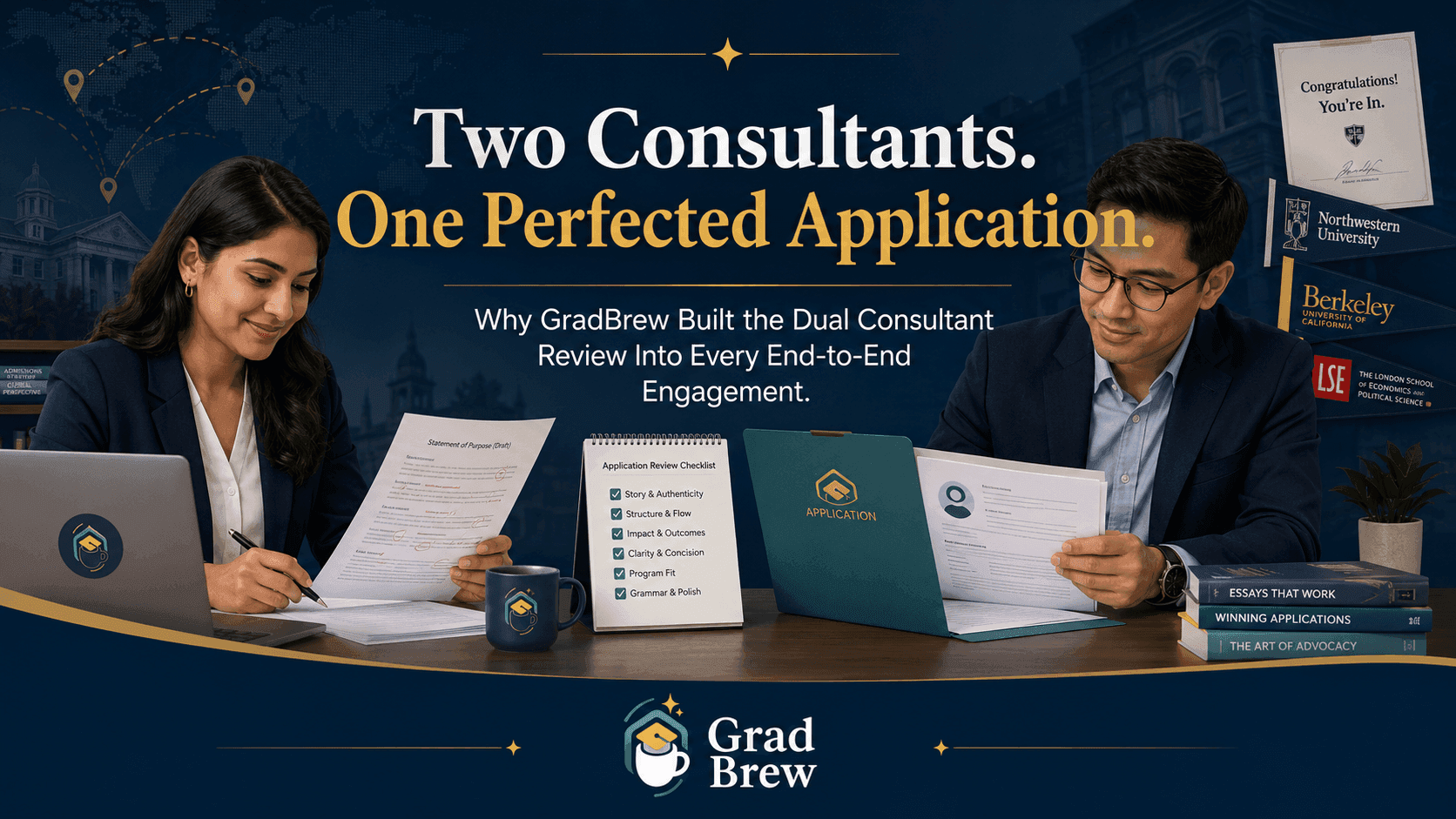
There is a quiet problem with how almost every admissions consultancy works.
Your consultant spends two, three, sometimes four months building your application with you. By the end of it, they know your story inside out. They have read every draft, sat through every call, edited every paragraph. And precisely because they know it so well, there are things they have stopped seeing.
This is not a failure of skill. It is a failure of perspective. Human reviewers develop blind spots after extended exposure to the same material. The longer you live with a draft, the harder it becomes to read it the way a stranger would, which is exactly how the admissions committee will read it on submission day.
The GradBrew dual consultant review exists to fix this structural problem. Every end-to-end engagement includes a second senior consultant who reviews your finalised application material with fresh eyes before you hit submit. This is not an upsell, not a premium add-on, not a marketing feature. It is built into the way we work because we do not believe a single consultant, no matter how good, can be the only set of eyes on a file that is going to a top global programme.
Here is how it works and why it matters.
Imagine you have edited your own essay fifteen times over six weeks. Read it now. You will read it the way you remember it, not the way it actually sits on the page. Your eye will slide past awkward phrasing because you have made peace with it. You will not notice the paragraph that no longer connects to the one above it after the last round of edits. You will miss the fact that your CV says one thing and your essay says another, because you wrote both and you know what you meant.
Now scale this to a consultant who has been building one candidate's full application across multiple schools, for months, alongside ten other candidates' files. The blind spots are real, predictable, and impossible to fully eliminate from the inside.
The only structural answer is a second reviewer who has not been in the build. Someone who sees the application the way the admissions committee will see it: cold, in one sitting, with no prior context to fill in the gaps.
That is what dual review is, and it is the most consequential ten percent of effort in the entire engagement.
The mechanics are straightforward.
After your lead consultant has worked with you through multiple rounds of edits, after the materials are at what both of you consider final or near-final standard, a second senior consultant enters. The second reviewer is either an alumnus of one of your target schools or a senior expert mentor with deep experience across the programmes you are applying to. Knowledge of the specific school's positioning, culture, and admissions priorities is the priority. We do not assign reviewers based on availability. We assign based on fit.
The second consultant reviews everything that is going to the school. CV. SOP. Every essay. Every LOR draft you are coordinating. Any school-specific supplemental materials. The full file as the adcom will see it.
Their job is to read with fresh eyes and ask the questions the adcom will ask. Does the story hold together when the pieces are read in sequence? Do the timeline references in the CV align with the timeline references in the essays? Does the recommendation letter reinforce the candidate's narrative or accidentally contradict it? Does the school-specific positioning actually match what this programme looks for, or is it generic? Is there any line, anywhere in the file, that an adcom could read uncharitably?
They produce feedback. Sometimes that feedback is "this is tight, ship it." Sometimes it is "the third paragraph of essay two undercuts the trajectory you established in essay one, here is why and here is what to consider." Either way, you and your lead consultant decide what to incorporate before submission.
The candidate hits submit with two senior people from two different perspectives having signed off on the file. Not one.
The kind of issues dual review catches are rarely about grammar or polish. Your lead consultant will have handled those long before this stage. What dual review catches is structural, narrative, and contextual. The things you cannot see from inside the build.
A few illustrative examples of the kinds of catches we see across our engagements. These are composites, not specific candidates, but every pattern below has come up in real reviews.
The timeline mismatch. A candidate's CV shows a promotion in early 2023. One of the essays describes a project that, on close reading, was clearly executed in the role the candidate held before the promotion. Not a lie, just a sloppy attribution that an adcom familiar with corporate timelines would flag. The lead consultant, who had read both documents at different times across the engagement, never put them side by side in one reading. The second reviewer did, in their first hour.
The narrative drift. A candidate's first essay positions them clearly as a future operator in renewable energy. Their second essay, written four weeks later for a different school, leans heavily into financial services as a career goal because the prompt nudged that direction. Both essays are individually strong. Read together, they suggest a candidate who does not actually know what they want. The lead consultant had written feedback on each essay in isolation and missed the cumulative inconsistency.
The school-fit gap. A candidate writes a "Why this school" essay for a programme known for its tight-knit cohort and emphasis on community. The essay is technically well-written but lists academic and career reasons exclusively, with no genuine engagement with the school's community values. A second reviewer who attended that programme spots the mismatch immediately, where a lead consultant from a different school might miss the specific cultural cue.
The LOR contradiction. A candidate's recommendation letter, drafted in coordination with their recommender, emphasises the candidate's analytical strengths. The candidate's own essays emphasise leadership and people management. Not a contradiction, but a missed opportunity: the LOR could have reinforced the leadership narrative the candidate is building, and instead it is pulling in a parallel direction.
The single line that lands wrong. Somewhere in essay four, there is a sentence that, on tenth reading, the lead consultant has stopped noticing. To a fresh reader, it lands as defensive, or arrogant, or vague. One sentence. The kind that could turn a 7 out of 10 essay into a 9.
These are not catastrophic errors. They are the marginal differences between an application that gets an interview invitation and one that does not. Top programmes are decided in the margins.
The honest answer is cost.
Dual consultant review requires a second senior consultant's time on every file, for every school, before submission. That time is not free. For a consultancy running on volume, this is not just an extra expense, it is a margin-evaporating decision that breaks the unit economics of their model.
So most consultancies do not do it. Some will offer it as a premium upsell. Some will describe a "senior review" that is in fact a 15-minute scan rather than a full review. Some will simply not mention the issue at all and rely on the assumption that one consultant is enough.
We believe one consultant is not enough, and we have built the business model to accommodate that belief. Our pricing reflects the additional senior hours that dual review requires. Our engagement model assumes serious depth on every file rather than light touch across many. This is why we work with a smaller number of candidates per cycle than a volume consultancy and put genuine effort behind each one.
It is the difference between working seriously with ten candidates and superficially with twenty. We have chosen the first model. We are happy to lose the second kind of business.
The case for dual review gets stronger the more competitive the programme.
At a programme with a 10 to 15 percent admit rate, the application has to be near-flawless. Adcoms read thousands of files per cycle. The bar at the margin is brutal. Every line of your application is competing against every line of someone else's application from a candidate with a comparable profile. The differences between "admitted" and "waitlisted" are often invisible to the candidate writing the file and obvious to a third reader reading cold.
This is exactly the gap dual review closes. You do not get a second chance on submission day. The application either represents you at your sharpest or it does not.
Dual review only works if the candidate is willing to engage with the feedback.
When the second reviewer flags something, you have three choices: incorporate the feedback, push back with reasoning, or override based on your own conviction. All three are valid responses. What does not work is treating the second review as a rubber stamp. The whole point of bringing in fresh eyes is to make the application better, which means some of what they catch will require you to revise material you thought was finished.
Most candidates find this stage clarifying rather than frustrating. It is the moment where the application stops being an open project and starts feeling complete. The candidates who get the most out of dual review are the ones who arrive at it ready to make one more set of refinements, not ready to defend every existing word.
Dual consultant review is included in our end-to-end packages, not offered as an upsell. If you are working with GradBrew on the full application journey, every school in your list will go through this process before submission. We do not sell it separately because we do not believe a serious application should ever go out without it.
This is one of the structural reasons end-to-end engagement is the model we recommend. The pieces, including dual review, only work properly when they fit together as one coherent process from profile evaluation to submission.
You have one shot per school, per cycle. The application you submit is the application the adcom reads. There is no editing once it is in.
Dual consultant review is the simplest, most operationally honest answer we have found to the question of how to make sure that file goes out as sharp as it can be. Two senior consultants from two different vantage points, both signing off, before you hit submit.
It is more work for us. It is the right amount of work for an application that represents the next chapter of your life.
You are a candidate with dreams, not a conversion to be processed. Your file deserves more than one set of eyes.
Brew your best,
Team GradBrew